In Preparation for Oculi—the Third Sunday in Lent
To beat down Satan under our feet: We implore You to hear us, good Lord.

Teaching for the Week: Apology of the Augsburg Confession, Article II: 46–50
46 Although the scholastics extenuate both sin and punishment when they teach that man, by his own strength, can fulfil the commandments of God; in Genesis the punishment, imposed on account of original sin, is described otherwise. For there human nature is subjected not only to death and other bodily evils, but also to the kingdom of the devil. For there, Gen. 3:15, this fearful sentence is proclaimed: I will put enmity between thee and the woman, and between thy seed and her seed. 47 The defects and the concupiscence are punishments and sins. Death and other bodily evils, and the dominion of the devil, are properly punishments. For human nature has been delivered into slavery and is held captive by the devil, who infatuates it with wicked opinions and errors, and 48 impels it to sins of every kind. But just as the devil cannot be conquered except by the aid of Christ, so by our own strength we cannot free ourselves 49 from this slavery. Even the history of the world shows how great is the power of the devil’s kingdom. The world is full of blasphemies against God and of wicked opinions, and the devil keeps entangled in these bands those who are wise and 50 righteous [many hypocrites who appear holy] in the sight of the world. In other persons grosser vices manifest themselves. But since Christ was given to us to remove both these sins and these punishments, and to destroy the kingdom of the devil, sin and death, it will not be possible to recognize the benefits of Christ unless we understand our evils. For this reason our preachers have diligently taught concerning these subjects, and have delivered nothing that is new, but have set forth Holy Scripture and the judgments of the holy Fathers.
Collect:
O God, whose glory it is always to have mercy, be gracious to all who have gone astray from Your ways and bring them again with penitent hearts and steadfast faith to embrace and hold fast the unchangeable truth of Your Word; through Jesus Christ, Your Son, our Lord, who lives and reigns with You and the Holy Spirit, one God, now and forever.
Hymn of the Day: LSB 666 O Little Flock, Fear Not the Foe
Legend has it that Swedish Lutheran soldiers sung this hymn as they marched into battle against their Roman Catholic enemies. The hymn exhorts Christians to not fear their enemy the devil (and by extension all his works and all his ways) for Christ their champion fights for them. Kids love hymns like this. Teach them the words to sing against their old evil foe. They know the voice of their Shepherd and trust Him.
Listen to a beautiful organ rendition here: O Little Flock, Fear Not the Foe
Old Testament: Exodus 8:16-24
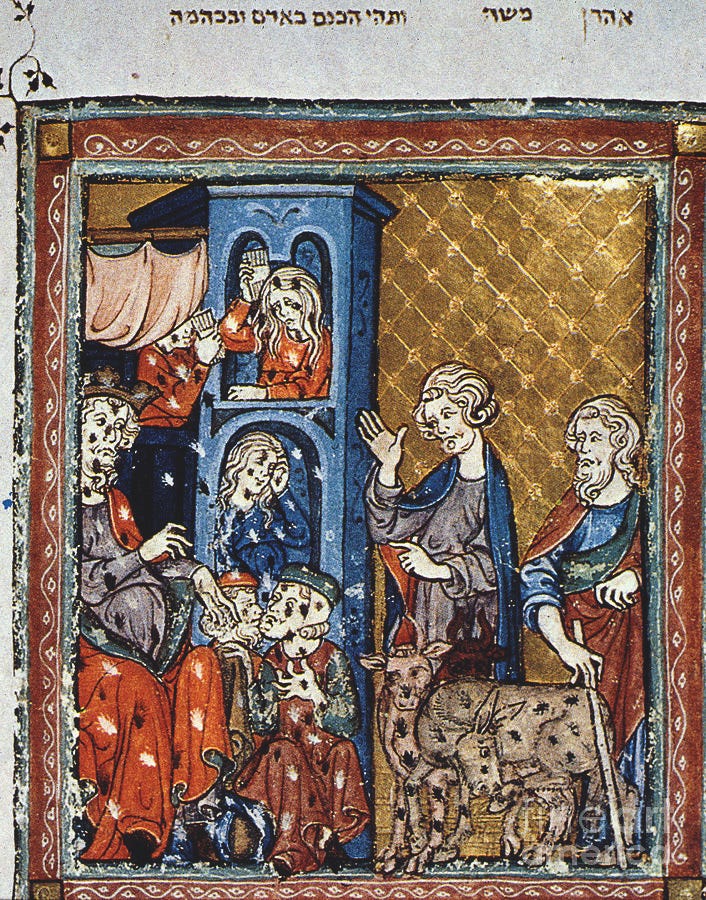
There are two helpful observations to be made on this reading—why pick these two plagues out of the ten? In the third plague—the plague of lice—the magicians of Pharaoh are stopped. They cannot imitate Aaron this time. In this helplessness they realize who they really are dealing with: “This is the finger of God.” Aaron and Moses are not here on their own showing off or making a power grab. Instead it is the true God who is at work judging Pharaoh’s unbelief and hardness of heart.
The second helpful observation made by the Holy Spirit is that God makes a difference between his people and Pharaoh’s (v.23). Unfortunately, we miss this in our English translations. Literally, what God puts between his people and Pharaoh’s is a “redemption” or “ransom.” The sign of this “redemption” is that there would be no flies in the land of Goshen where God’s people dwelt. But how are flies to know where they are and are not allowed to go? Clearly it was a miracle. It was a divine sign of the redemption that distinguishes God’s people from Pharaoh’s. As Psalm 130:7–8 says, “O Israel, hope in the Lord! For with the Lord there is mercy and with him is plentiful redemption. And He shall redeem Israel from all his iniquities.”
Epistle: Ephesians 5:1-9
There are two paths to walk: one in the light and love of Christ and one in the dark and trespasses. The Christian is made alive and, like a child, learning to walk and to do the things his father does. So the Christian imitates Christ. He loves as Christ loved. He has been filled with the Spirit and, now that he is a good tree, bears the good fruits of the Spirit: goodness, righteousness and truth. To speak things or think things that are not good and righteous and true are to poison the tree and to unbind the devil and sin that has been tied down by Christ. Let it not even be named among you. Think of the children of Israel and how they wanted to go back to Egypt all those times. Was it really that good being a slave? Maybe the joke was funny, but do you really want to go back to being a slave of sin? Do not imitate slaves. Imitate Christ. And give Him thanks for His great redemption.
Gospel: Luke 11:14-28
The occasion for this sermon of our Lord is him exorcising a demon. Jesus, exercising his divine power in perceiving their thoughts, knows that sinful man cannot understand either his person or his work. The work was clear but the crowd doesn’t want to accept its consequences. If he casts out demons by the power of Satan, then he is not God. But if he casts out demons by the power of God, he must be the Messiah and God Himself.
Jesus makes a simple argument: does it really make sense that in a battle it would be in any way advantageous to set one portion of your army against the other all the while being faced down by the real enemy? Of course not. Satan does not want his demons cast out. They want to crowd together and reinforce one another. No, if the Strong Man of this world—whom St. Paul calls “the god of this world” (2 Corinthians 4:4)—is defeated and despoiled and bound, then the binder must be even Stronger. As the hymn puts it, “Christ Jesus, God’s own Son, came down, His people to deliver; destroying sin, He took the crown from death’s pale brow forever: Stripped of power no more it reigns; an empty form alone remains; its sting is lost forever. Alleluia!”
The crowd is completely concerned with the mechanism of the exorcism. They want to know how it worked. They miss the despoiling and binding that Jesus teaches about. They know their demonology. They know that in the Old Testament (see 2 Kings 1) Beelzebub (one of the gods of the Philistines—literally either “lord of flies” or “lord of dung”) had a reputation for performing wonders similar to the magicians of Pharaoh. In Mark’s account (3:22) they suggest that Jesus is possessed by a demon and literally doing the will of Satan.
But Jesus’ finger that casts out the demon is literally the finger of God. We learn who Jesus is from the work he does. He is true God and true man “came down from heaven to deliver his people.” Last week we were reminded that sin is not created by God but instead comes from the devil and the perverted will of man and sin is punished by God with death. So Jesus came to redeem man from sin by means of his holy precious blood and with his innocent suffering and death. This suffering and death bound the devil—the Strong Man—and despoiled him of his panoply of sin and death. Jesus died, was buried, and descended into hell to preach his victory over the Strong Man and bind him to his eternal punishment and shut the gates of hell to believers so that they might never taste the wrath of God that remains upon the devil and upon unbelievers. St. Paul rejoices over this victory singing, “O death, where is thy sting? O grave, where is thy victory? The sting of death is sin; and the strength of sin is the law. But thanks be to God, which giveth us the victory through our Lord Jesus Christ” (1 Corinthians 15: 55–57).
However, knowing the mechanism isn’t enough. Christ must be grasped by faith. His work must be grasped by faith. If the house is swept clean but the doorposts and gates do not bear the Word of God (Deuteronomy 6:9), and if the heart does not hear and keep the Word of God, then the house has merely been prepared for a new demonic inhabitant like some cheap VROB.
“On my heart imprint Thine image, blessed Jesus, King of Grace,
That life’s riches, cares, and pleasures
Have no pow’r Thee to efface.
This the superscription be: Jesus, crucified for me,
Is my Life, my hope’s Foundation,
And my Glory and Salvation. Amen.” (TLH 179)
Prayer on the Third Sunday in Lent: “Lord God, heavenly Father, who sent Your Son, our Lord Jesus Christ, to be made man, that He might crush the devil’s tyranny and protect us men from our wicked adversary: we thank You for this gracious help, and we beseech You in all tribulations graciously to come to our aid, to keep us from complacency, and by Your Holy Spirit mercifully to sustain us in Your Word and holy fear, that we may abide in peace from the evil foe until our end, and through Your Son obtain eternal salvation. Amen.” (Lutheran Prayer Companion, 45)