Family Devotions
Encouragement and advice to starting or improving a habit this year

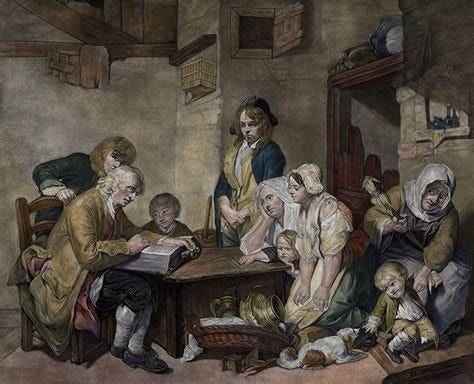
Every Christian knows that he should pray and read his Bible, but many simply don’t know how to start and how to get the habit to stick. This article is intended as encouragement and advice coming from my experience first as a son, and then as a father. This article is aimed at fathers primarily (as the heads of their household) but also to all Christians generally who desire to know their Lord and His will better.
Part of the challenge to making family devotions a sticking habit is that there is no command in the New Testament detailing what exactly to read and what exactly to pray or how much or how often. Instead, one finds passages like: “pray without ceasing” (1 Thess. 5:17) or 2 Timothy 3:15 where Timothy just “is familiar” with the Holy Scriptures due to the piety and faithfulness of his mother and grandmother. But what do you actually do?
We can approach this question in two ways. One way would be to take an historical perspective and describe how individuals and families and other smaller groups (without a pastor) conducted daily devotions. For most people, the most accessible version of this is found in your hymnal. That’s what Matins and Vespers are for (LSB 219 and 229 respectively). The problem with this is that it is too much for most people to start out with. No weightlifter starts with his 500 lbs lift without first training up to it, or even without warming up. You can’t just sign up for a marathon and expect to be successful without training and preparation.
For that reason, if you do not have a habit of family devotions and just feel overwhelmed by the idea, I’m going to describe a simpler approach than jumping into Matins with all its parts. This is what I grew up doing under the leadership of my father and it is what his father and grandfather before him also did in the home. It is simple (think KISS) and simple is good for both learning and for children. This format includes the basics of reading the Bible and prayer. That’s it. This is the skeleton of piety in the home and the basic building blocks of handing down your faith to your children. From this skeleton you can add and modify as needed and desired.
Basic format (each part will be described in detail below):
1. Invocation: In the Name of the Father and of the Son and of the Holy Spirit. Amen.
2. Read: Selection from the Bible
3. Discuss
4. Pray
1. We begin with the invocation because we do not receive faith or strengthen our faith by our own reason or strength, but only by the power of the Holy Spirit who is given us in baptism and through the Word of God. For that reason, we begin in His Name. Jesus says, “Ask, and it shall be given you; seek, and ye shall find; knock, and it shall be opened unto you: For every one that asketh receiveth; and he that seeketh findeth; and to him that knocketh it shall be opened” (Matt. 7:7–8). I sometimes also follow this with the following prayer:
Blessed Lord, You have caused all Holy Scriptures to be written for our learning. Grant that we may so hear them, read, mark, learn, and inwardly digest them that, by patience and comfort of your holy Word, we may embrace and ever hold fast the blessed hope of everlasting life; through Jesus Christ, our Lord. Amen. (LSB p.308)
This is the way you teach kids. You just repeat it every day. You don’t have to explain it. Just repeat it and they will know it within the week and stay with them forever.
2. Now comes the main event. You read the Bible with your family because in its words is Life—even Jesus Christ our Lord (John 5:39–40). There are (at least) three ways to approach this. The Bible is a big book with lots of story lines, characters, and doctrines all woven together. Moreover, there are varying levels of difficulty. Some things are clear and straight forward (like the historical books or the events in the life of Christ) while others require familiarity with the stories and works of God recorded in them. If you start with Revelation, or Ezekiel or Song of Songs you will read less profitably than if you start with Matthew, Mark, Luke, John and Genesis.
Growing up, we read one chapter a day. Period. We didn’t skip anything, but read the awkward, the long and the boring. This approach has the advantage of determinedly plodding through towards the goal of reading the entire Bible. Afterall, “every word of Scripture is God-breathed and is profitable…” (2 Tim. 3:16–17). The problem with this approach is that it assumes other instruction in the faith is happening in the home. Everyone simply needs to know the basic Bible stories (how the earth was created, what the Patriarchs did, who was King David, what did Jesus do, etc.). In a home already filled with Bible stories and Lutheran hymns and familiarity with the Small Catechism, this approach is a beautiful and effective way to teach your family the “whole council of God” (Acts 20:27).
I use this with my family now, but for the first several years as a husband and then father, I chose a different approach. I wanted to make sure my wife and I knew the same Bible stories and basics of Christian doctrine and, before God gave us children, it was easier to find excuses to skip devotions. During this time, I used a set lectionary that walked through much of the Bible (and often keyed to the Church Year). We used the Treasury of Daily Prayer published by CPH. This is an invaluable resource if you are beginning to do family devotions (more below). This is a mediating approach. It is not quite as extensive a reading of Scripture as just reading straight through, but more thorough than what follows.
The third approach is for those who know very little of the Bible or are new to the faith. For you, the priority is familiarity with the teaching and work of Jesus Christ as recorded in the Gospels. To achieve this familiarity, start with Mark or with John. The benefit of Mark is that it is short and to the point. It’s like working out. You need to build fitness without straining a muscle or discouraging yourself. Start small. Read Mark 1:1–8 the first day and Mark 1:9–13 the next. You will increase naturally. You won’t be able to help it. Start small and then ask: “Ok, what does it mean the Mark describes Jesus as the Son of God? What does the word “repentance” mean? Why is John the Baptist so weird? You probably won’t be able to answer most of your own questions at first. That’s ok. Write them down on a piece of paper that you can use as a bookmark and keep going. Ask them to your pastor later or look for them as you keep reading.
3. This is the hardest part. There are different ways this part of devotions can look. If you are really time-crunched, it is enough to simply read the Bible, pray and get on with your day. Simply imitate Mary and ponder these things in your heart throughout the day. But it is very helpful to discuss it as a family. This teaches you, as a family, to talk theology with one another. Very simply it consists of “what does this mean?” followed by an attempt to answer it from Scripture and the clear meaning of words. Always, ask “where is Jesus? How does this text point to Jesus and teach his work of atonement?”
As you and your family become more comfortable, your questions will become more complex. Try to think in terms of the Six Chief Parts: “What commandment does this teach? What article of the Creed does this teach? Which petition of the Lord’s Prayer is this? What sins should we confess? Etc.” Another thing you can add here is a devotional writing by one of our Lutheran fathers, or an excerpt from the Small or Large Catechism. I will list some of my favorites below.
This portion of your family devotions should also eventually include the singing of hymns. You may not like singing or think you are good at it, but your kids need it. There is no single more effective way to plant the Word of God in their hearts and souls than by the singing of hymns. And for their sake, don’t teach them empty hymns or doctrinally squishy hymns. Treat the choosing of hymns like choosing food for your kids: give them eggs not breakfast cereal. One will hurt them and leave them hungry in five minutes, the other will support healthy growth and endure. If you don’t know what hymns to learn, ask your pastor. I will try to post a list of suggested hymns soon as well.
4. Finally, you need to pray. Sometimes you will have personal needs that you must bring before God: “Lord, strengthen my faith,” “Lord, teach me your will with regard to x,” “Lord please send your holy angels to watch over so and so as he travels,” “Lord, watch over my dying relative and keep him strong in the one true faith,” etc.”
Every time, it is a good habit to pray the following three: The Apostles’ Creed, The Lord’s Prayer, and Luther’s Morning/Evening Prayer. If you or your family do not have these memorized, it is very helpful to write them out or print them and simply read them together until you have them memorized.
Conclusion
That’s it. It’s a lot of words to describe a process that can take as little as 5 minutes (trust me, I timed it as a kid). Usually ours last 10–15 minutes, but everyone gets busy and you simply must pray and read the Bible with your family even when you are busy.
You can add all sorts of things to this skeleton. I teach my family at least the first stanza of the hymn of the day for the coming Sunday. In this way, my kids begin to learn a specifically Lutheran expression of the faith and they have one more part of the liturgy they can participate in on Sunday morning. And who doesn’t love hearing your kids sing “I build on this foundation, that Jesus and His blood / alone are my salvation, my true eternal good…” (LSB 724.2) in Walmart at the top of their lungs? Bring your bulletin home on Sunday and pray the Collect of the Day from the previous Sunday (or the upcoming Sunday if you are trying to prime your ears for the sermon).
You can and should pray the Psalms. We do this seasonally in my family. Here’s what I mean: in Advent and Christmas, I taught my family Psalm 2 because it is explicitly about the Christ. In the summer, we learned Psalm 1. There is never a bad time to learn Psalm 23 or 121 or 130 or 127 and 128. (In fact, if you are having a hard time as a father or mother and the crosses God places on fathers and mothers, read Psalm 127 every day and see what happens).
There still are no rules or prescribed processes. It isn’t a Bible verse, but it gets to the point: just do it. The simplicity of this Christian requirement overwhelms people. Just do it. Just start. Read a few verses of Mark and pray the Lord’s prayer. Then go about your day in the joy and certainty that the blood of Jesus Christ, the Son of God, cleanses you from all sin. Your works—your piety, your earnestness, your scholarly ability—will never save you. Instead, read the Bible and pray simply for the joy of what is contained in it. It is a treasure to be explored, not a weight to be lifted. It will work like an exercise in your life because your flesh is still weighed down by sin. But you are already holy by virtue of faith in Jesus Christ.
“I have longed for thy salvation, O Lord; and thy law is my delight. Let my soul live, and it shall praise thee; and let thy judgments help me. I have gone astray like a lost sheep; seek thy servant; for I do not forget thy commandments” (Psalm 119:174–176).
Resources:
Different people need different tools in their toolbox. I am only listing a few resources for two reasons. First, and most importantly, nothing compares to just getting into the Bible and reading it for yourself. Believe it or not, it is actually more clear and straightforward than many of the commentaries and “intellectual” reflections upon the Word of God. Scripture is actually clear, and you don’t need anything special to find your Lord Jesus within its pages. Second, there is no point in starting a new habit with bad material. Again, think about it like weightlifting or exercising: don’t start a new regimen with bad technique. For that reason, the resources below are tried and true Lutheran devotional materials. There are always more out there. I am assuming you already have a Bible (get one with maps!), a hymnal (preferably a Lutheran Service Book and a The Lutheran Hymnal), and a Small Catechism.
1. Treasury of Daily Prayer, CPH 2008. I used this with my family for many years. What I find particularly helpful is that this volume has readings dated (i.e., January 1, January 2, etc.). For every day the Treasury has a Psalm, an OT reading, a NT reading as well a “writing”—an excerpt from a sermon or other writing of either a church father or a Lutheran reformer. They also suggest a hymn verse for the day and a prayer for the day as well as a reading from the Book of Concord, if you wish to follow their reading plan through the Lutheran Confessions.
Having dated readings was invaluable for my family cementing the habit of daily devotions. For us, the date was an accountability method that made it much harder to skip a day. The other advantage of this book is the sheer amount of material presented in such a way that you can pick and choose what you need for your family and your time frame. My only complaint is the “writings.” Often they are very good, but occasionally they are from a church father who simply spoke in different ways than we do, resulting in confusing doctrine. If you purchase this book, spend some time flipping through it and familiarizing yourself with its resources.
2. Reading the Psalms with Luther, CPH 2007. This simple volume is just the Psalms with Luther’s introductions at the beginning of each and ending with a prayer reflecting upon the Psalm ending each entry. The great value of this book is that it teaches you how to read the Bible by asking, for each Psalm, “what commandment is it teaching?”, “what article of the Creed?”, “what petition of the Lord’s Prayer?” This book works particularly well for personal praying of the Psalms, although it is a great tool for learning how to talk about the Bible with your family.
3. Lutheran Prayer Companion, CPH 2018. I recently discovered this treasure, and I cannot believe every Christian doesn’t use it every day. If you want to learn how to pray, here is your teacher. Learn by imitation. It is a translation of prayers collected and preserved from 16th and 17th century Germany. You will be amazed the way the prayer writers breath out Scripture. Each prayer is tapestry of Bible verses woven together and offered up to God concerning a particular topic. This book contains prayers for all sorts of life circumstances that you will struggle to find words for in other modern prayer books (for example, Prayer against Slanderers, or Prayer of an elderly person who has been abandoned, or Prayer when a wife is fearful before the birth, or Prayer when the blessing of children is detected). I have found the collection of prayers for each Sunday in the church year to be particularly fruitful. Likewise, there are beautiful prayers for each day (three, in fact): a morning benediction, a meditation on one of the petitions of the Lord’s Prayer, and an evening benediction.
4. Crumbs: Short Devotions for Every Day of the Year, CPH 1914. This gem is a translation of devotions by a pastor named C. M. Zorn. Rev. Zorn was the pastor to young pastor Francis Pieper. Pieper’s wife was a member of Zorn’s congregation and married the two of them shortly into Pieper’s pastorate. This volume consists of short commentaries (two or three paragraphs) on a single verse drawn from the previous Sunday’s readings. Yes, this is unashamedly a resource for those of you using the historic lectionary. Zorn is clear, concise and very comforting. The atonement is at the center of almost every reading. Imagine that! And each day ends with a brief prayer. The language is King James English, but if you read slowly and intentionally you won’t notice after a while.
5. God Grant It: Daily Devotions from C.F.W. Walther, CPH 2006. As with the previous book, this volume also unashamedly supports the historic lectionary. It consists of excerpts from Walther’s sermons, broken into chunks to last through the week. So, if you want another perspective on Sunday’s sermon or a deeper explanation, then this book is for you. Each day has a single Bible verse to read followed by two or three pages of sermon and ending with a hymn verse to pray.